
SEARCH WHAT YOU WANT
Sneaker Cleaner Specifications: pH, Foam Density, Material Compatibility and Safety Standards Buyers Need to Know
Time:2026-09-15
A spec-grade sneaker cleaner is defined by four numbers: pH (6.0 to 8.5), solids content (3 to 8 percent), surfactant load (1.5 to 4 percent active matter) and peroxide concentration (0 to 3 percent for whitening formulas). Anything outside those ranges either fails on performance or fails on material safety. These four parameters, plus compliance with EN 71-3 toy safety and ISO 16128 natural-origin guidelines where relevant, are the technical baseline a distributor, retailer or reseller should require from any manufacturer before placing a private-label or wholesale order (source: ISO 16128 natural-origin guidelines, 2024).
1. The Specification Sheet a Buyer Should Request
| Parameter | Typical spec range | Why it matters | Test method |
|---|---|---|---|
| pH (neat) | 6.0 to 8.5 | Below 6 risks leather drying; above 8.5 risks dye migration on knit | pH meter, 25 C |
| Solids content | 3 to 8 percent | Too low = weak cleaning; too high = visible residue on foam midsoles | Oven-dry gravimetric |
| Active surfactant | 1.5 to 4 percent | Defines cleaning power per dose | Two-phase titration |
| Hydrogen peroxide | 0 to 3 percent | Whitening formulas; above 3 percent can bleach stitching dye | Iodometric titration |
| Foam half-life (50 ml) | at least 3 min | Longer foam contact = more dwell time on vertical panels | Foam stability rig |
| Viscosity | 20 to 200 cP | Controls how the product clings or runs off textured uppers | Brookfield viscometer |
| Microbial limits | TVC under 100 CFU/ml | Preservative system adequacy | ISO 21149 |
2. pH: The Single Most Misunderstood Number
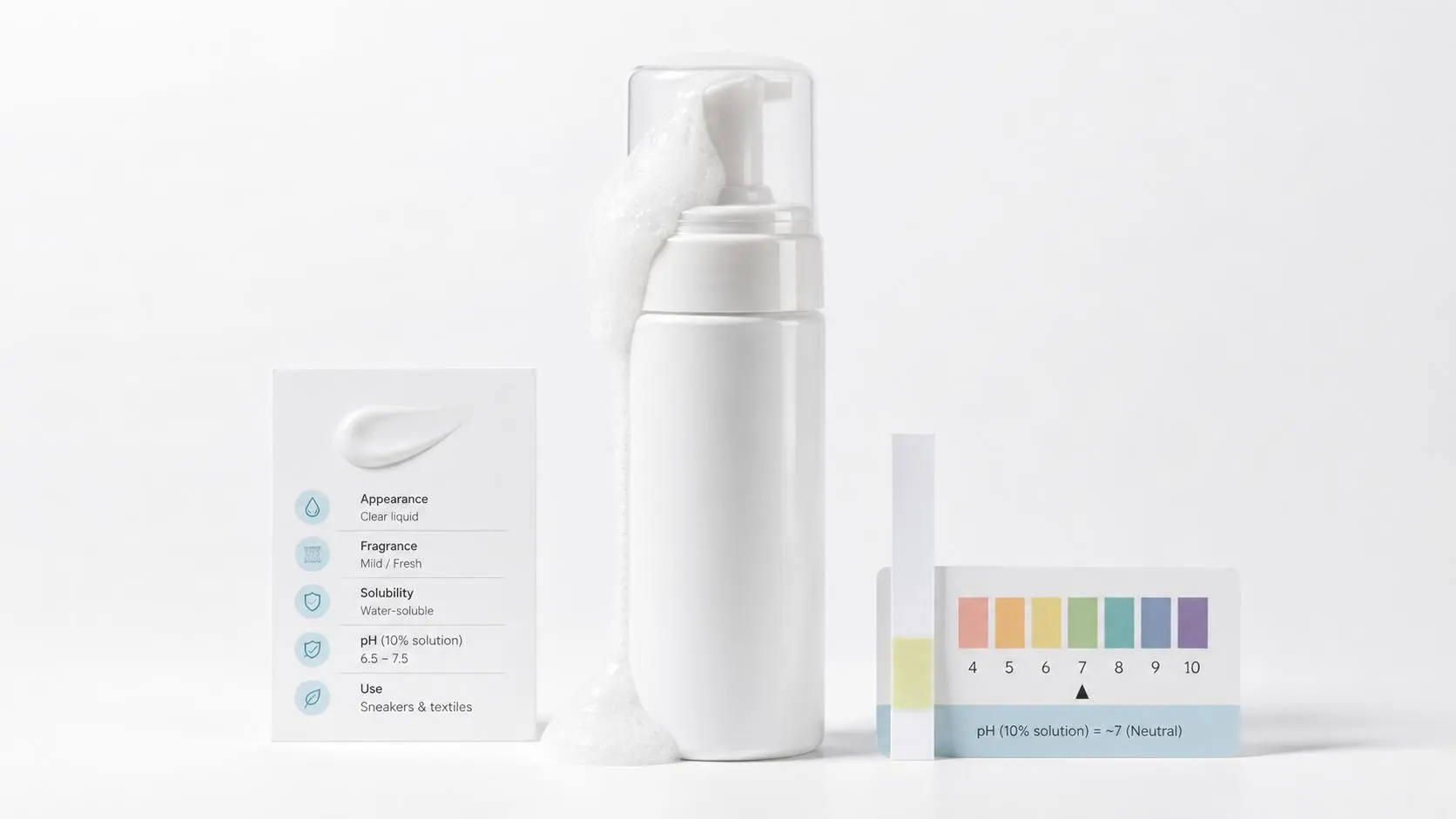
pH drives most of the damage and most of the performance in a sneaker cleaner. A pH below 6 starts to hydrolyze the protein structure of full-grain leather and can degrade the TPU films used on modern performance uppers. A pH above 8.5 can lift anionic dyes out of knit and printed panels, leaving the dreaded bleeding effect on a white-and-color sneaker. The industry consensus is a 6.0 to 8.5 band, with whitening formulas usually sitting at 6.5 to 7.5 to keep the peroxide stable (source: SNIA technical bulletin, 2023).
3. Foam Density and Foam Half-Life
Foam density controls two things: how much chemistry you deliver per pump, and how long it stays in contact with a vertical panel. A 50 ml foam column that holds its shape for at least 3 minutes is the rule of thumb resellers use when they evaluate a new supplier. Yinghuameng's whitening foam ships at a foam half-life of around 4 minutes, which is part of why it is the format most often recommended for the vertical midsole walls of Air Force 1s and Dunks.
4. What "How Much Power" Means in a Cleaning Context
Buyers searching for how much power a sneaker cleaner has are usually asking one of two things: either the surfactant load (active cleaning power) or the peroxide load (whitening power). A 1.5 percent surfactant formula is enough for weekly maintenance; a 3 to 4 percent surfactant formula is what a reseller uses on a pair that has been worn through a festival season. A 0 percent peroxide formula is a general cleaner; a 1 to 3 percent peroxide formula is a whitening system.
5. Material Compatibility Matrix
| Upper | Acceptable pH | Surfactant max | Peroxide allowed | Notes |
|---|---|---|---|---|
| Knit / Primeknit | 6.5 to 8.0 | 3 percent | 0 to 1 percent | Avoid higher pH to prevent dye bleed |
| Mesh | 6.5 to 8.0 | 3 percent | 0 to 2 percent | Standard format works |
| Suede / nubuck | 6.5 to 7.5 | 1.5 percent (dry bar only) | 0 percent | No liquid contact on the nap |
| Full-grain leather | 6.0 to 7.0 | 2 percent | 0 percent | Follow with a conditioner |
| Canvas | 6.5 to 8.5 | 4 percent | 0 to 2 percent | Most forgiving surface |
| TPU / synthetic | 6.5 to 8.0 | 3 percent | 0 to 1 percent | Wipe off residue quickly to prevent filming |
6. Safety and Compliance Standards to Verify
- EN 71-3 — toy-safety migration limits on heavy metals. Required if the product can plausibly contact skin (most sneaker cleaners can).
- ISO 16128 — natural-origin index, used to back up eco-friendly claims on the label.
- REACH SVHC declaration — confirms none of the 247 substances of very high concern are present above 0.1 percent.
- Microbial limits per ISO 21149 — total viable count under 100 CFU/ml and absence of Staphylococcus aureus, Pseudomonas aeruginosa and Candida albicans.
- Stability testing — 12 months at 25 C, 6 months at 40 C, 3 freeze-thaw cycles.
7. Packaging Specifications That Matter
A spec sheet is not complete without packaging data. For retail, a 100 to 150 ml foamer bottle with a 30 mm neck and a PET body is the standard format; for travel, a 30 to 50 ml refillable bottle; for reseller and distributor use, 500 ml and 5 L refill packs. A buyer should also confirm the bottle is HDPE or PET (recyclable in most municipal streams) and that the foamer head is replaceable — a foamer that cannot be replaced is the single most common complaint from professional users.
8. Yinghuameng Specifications at a Glance
Yinghuameng publishes a technical data sheet for each SKU. The whitening foam sits at pH 7.0, 4 percent solids, 2 percent active surfactant and 2 percent hydrogen peroxide, with a foam half-life of about 4 minutes. The dry cleaning bar is a 100 percent natural rubber block with no surfactants and no pH to speak of. Both products are tested to EN 71-3 and ship with the REACH SVHC declaration.
FAQ
What pH should a sneaker cleaner be?
6.0 to 8.5 is the standard band. Whitening formulas are usually in the 6.5 to 7.5 range to keep the peroxide stable.
How much surfactant is enough?
1.5 percent active surfactant is enough for routine maintenance. 3 to 4 percent is what a reseller or restoration shop wants for heavy soil.
What does "how much power" mean for a cleaner?
It usually refers to either surfactant load (general cleaning power) or peroxide concentration (whitening power). Both are listed on a proper technical data sheet.
What foam half-life should I require?
At least 3 minutes for a 50 ml foam column. Less than that and the product will not stay in contact with vertical panels long enough to clean them.
Is there a safety standard for sneaker cleaners?
EN 71-3 toy-safety migration limits are the de facto reference because the cleaner can plausibly contact skin. REACH SVHC, ISO 21149 microbial limits and ISO 16128 natural-origin index are the other three a serious buyer should ask for.
Does a higher solids number mean a better cleaner?
Not necessarily. Above about 8 percent solids, a water-based cleaner tends to leave visible residue on foam midsoles. The 3 to 8 percent range is the sweet spot.
Sources
ISO 16128 — Cosmetics: natural-origin guidelines (2024)
SNIA Technical Bulletin — pH and material compatibility in footwear care (2023)
EN 71-3 — Safety of toys, migration of certain elements
ISO 21149 — Cosmetics, microbiology, enumeration of aerobic mesophilic bacteria
A spec-grade sneaker cleaner is defined by four numbers: pH (6.0 to 8.5), solids content (3 to 8 percent), surfactant load (1.5 to 4 percent active matter) and peroxide concentration (0 to 3 percent for whitening formulas). Anything outside those ranges either fails on performance or fails on material safety. These four parameters, plus compliance with EN 71-3 toy safety and ISO 16128 natural-origin guidelines where relevant, are the technical baseline a distributor, retailer or reseller should require from any manufacturer before placing a private-label or wholesale order (source: ISO 16128 natural-origin guidelines, 2024).
1. The Specification Sheet a Buyer Should Request
| Parameter | Typical spec range | Why it matters | Test method |
|---|---|---|---|
| pH (neat) | 6.0 to 8.5 | Below 6 risks leather drying; above 8.5 risks dye migration on knit | pH meter, 25 C |
| Solids content | 3 to 8 percent | Too low = weak cleaning; too high = visible residue on foam midsoles | Oven-dry gravimetric |
| Active surfactant | 1.5 to 4 percent | Defines cleaning power per dose | Two-phase titration |
| Hydrogen peroxide | 0 to 3 percent | Whitening formulas; above 3 percent can bleach stitching dye | Iodometric titration |
| Foam half-life (50 ml) | at least 3 min | Longer foam contact = more dwell time on vertical panels | Foam stability rig |
| Viscosity | 20 to 200 cP | Controls how the product clings or runs off textured uppers | Brookfield viscometer |
| Microbial limits | TVC under 100 CFU/ml | Preservative system adequacy | ISO 21149 |
2. pH: The Single Most Misunderstood Number
pH drives most of the damage and most of the performance in a sneaker cleaner. A pH below 6 starts to hydrolyze the protein structure of full-grain leather and can degrade the TPU films used on modern performance uppers. A pH above 8.5 can lift anionic dyes out of knit and printed panels, leaving the dreaded bleeding effect on a white-and-color sneaker. The industry consensus is a 6.0 to 8.5 band, with whitening formulas usually sitting at 6.5 to 7.5 to keep the peroxide stable (source: SNIA technical bulletin, 2023).
3. Foam Density and Foam Half-Life
Foam density controls two things: how much chemistry you deliver per pump, and how long it stays in contact with a vertical panel. A 50 ml foam column that holds its shape for at least 3 minutes is the rule of thumb resellers use when they evaluate a new supplier. Yinghuameng's whitening foam ships at a foam half-life of around 4 minutes, which is part of why it is the format most often recommended for the vertical midsole walls of Air Force 1s and Dunks.
4. What "How Much Power" Means in a Cleaning Context
Buyers searching for how much power a sneaker cleaner has are usually asking one of two things: either the surfactant load (active cleaning power) or the peroxide load (whitening power). A 1.5 percent surfactant formula is enough for weekly maintenance; a 3 to 4 percent surfactant formula is what a reseller uses on a pair that has been worn through a festival season. A 0 percent peroxide formula is a general cleaner; a 1 to 3 percent peroxide formula is a whitening system.
5. Material Compatibility Matrix
| Upper | Acceptable pH | Surfactant max | Peroxide allowed | Notes |
|---|---|---|---|---|
| Knit / Primeknit | 6.5 to 8.0 | 3 percent | 0 to 1 percent | Avoid higher pH to prevent dye bleed |
| Mesh | 6.5 to 8.0 | 3 percent | 0 to 2 percent | Standard format works |
| Suede / nubuck | 6.5 to 7.5 | 1.5 percent (dry bar only) | 0 percent | No liquid contact on the nap |
| Full-grain leather | 6.0 to 7.0 | 2 percent | 0 percent | Follow with a conditioner |
| Canvas | 6.5 to 8.5 | 4 percent | 0 to 2 percent | Most forgiving surface |
| TPU / synthetic | 6.5 to 8.0 | 3 percent | 0 to 1 percent | Wipe off residue quickly to prevent filming |
6. Safety and Compliance Standards to Verify
- EN 71-3 — toy-safety migration limits on heavy metals. Required if the product can plausibly contact skin (most sneaker cleaners can).
- ISO 16128 — natural-origin index, used to back up eco-friendly claims on the label.
- REACH SVHC declaration — confirms none of the 247 substances of very high concern are present above 0.1 percent.
- Microbial limits per ISO 21149 — total viable count under 100 CFU/ml and absence of Staphylococcus aureus, Pseudomonas aeruginosa and Candida albicans.
- Stability testing — 12 months at 25 C, 6 months at 40 C, 3 freeze-thaw cycles.
7. Packaging Specifications That Matter
A spec sheet is not complete without packaging data. For retail, a 100 to 150 ml foamer bottle with a 30 mm neck and a PET body is the standard format; for travel, a 30 to 50 ml refillable bottle; for reseller and distributor use, 500 ml and 5 L refill packs. A buyer should also confirm the bottle is HDPE or PET (recyclable in most municipal streams) and that the foamer head is replaceable — a foamer that cannot be replaced is the single most common complaint from professional users.
8. Yinghuameng Specifications at a Glance
Yinghuameng publishes a technical data sheet for each SKU. The whitening foam sits at pH 7.0, 4 percent solids, 2 percent active surfactant and 2 percent hydrogen peroxide, with a foam half-life of about 4 minutes. The dry cleaning bar is a 100 percent natural rubber block with no surfactants and no pH to speak of. Both products are tested to EN 71-3 and ship with the REACH SVHC declaration.
FAQ
What pH should a sneaker cleaner be?
6.0 to 8.5 is the standard band. Whitening formulas are usually in the 6.5 to 7.5 range to keep the peroxide stable.
How much surfactant is enough?
1.5 percent active surfactant is enough for routine maintenance. 3 to 4 percent is what a reseller or restoration shop wants for heavy soil.
What does "how much power" mean for a cleaner?
It usually refers to either surfactant load (general cleaning power) or peroxide concentration (whitening power). Both are listed on a proper technical data sheet.
What foam half-life should I require?
At least 3 minutes for a 50 ml foam column. Less than that and the product will not stay in contact with vertical panels long enough to clean them.
Is there a safety standard for sneaker cleaners?
EN 71-3 toy-safety migration limits are the de facto reference because the cleaner can plausibly contact skin. REACH SVHC, ISO 21149 microbial limits and ISO 16128 natural-origin index are the other three a serious buyer should ask for.
Does a higher solids number mean a better cleaner?
Not necessarily. Above about 8 percent solids, a water-based cleaner tends to leave visible residue on foam midsoles. The 3 to 8 percent range is the sweet spot.
Sources
ISO 16128 — Cosmetics: natural-origin guidelines (2024)
SNIA Technical Bulletin — pH and material compatibility in footwear care (2023)
EN 71-3 — Safety of toys, migration of certain elements
ISO 21149 — Cosmetics, microbiology, enumeration of aerobic mesophilic bacteria
Contact Us
Tel: +86 510 8659 6258
Address: No.3 Beihuan Road, Yuecheng Town, Jiangyin, Jiangsu Province, China.

Copyright © 2026 Jiangyin Yinghuameng Houseware Co., Ltd.